
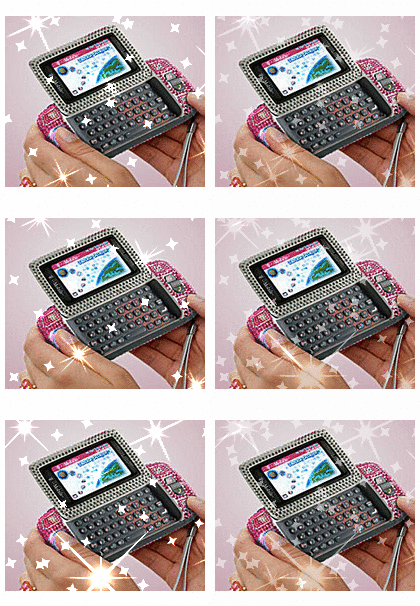
Wireless communication refers to the transfer of information without the use of wires across a distance. The distance can be as short as a few meters or as long as hundreds of kilometers. Mobile phones, PDAs, wireless networks and satellite TV are only few of the wide variety of fixed, mobile or portable devices and systems that employ wireless communication technology.
The cellular concept was introduced in the 1960s and 1970s, since then the communication industry has witnessed enormous growth. Wireless communication networks have become omnipresent and the worldwide cellular subscriber base is expected to cross 5.5 billion users in 2013, with a growth rate of 40% or more a year!
The sharp increase in cellular subscribers over recent years shows that wireless communications are a robust and sustainable voice and data transport system. Newer wireless systems and technology include voice and data in addition to voice phone calls.
The first generation wireless communication systems were launched in 1980s (1G) which used analog signals for communication and relied on TDMA technology alone. These were replaced by the second generation (2G) systems in 1990s which used digital signals and could transmit data in addition to voice. GSM is an important 2G standard. 2G was upgraded to 2.5G to give better data speeds. Services like GPRS, EDGE and WAP were introduced with it for mobile browsing. Introduced in 2001, the 3G systems made simultaneous transmission of voice and data possible. In addition to high speed internet access, facilities such as video calling and mobile TV are now possible. Meanwhile, 3G is evolving into 3.5G with features like WiMax, 4G is expected to provide IP based services. That means in the future every device will have a unique IP Address.
At the same time as cellular networks develop new standards to facilitate high speed data communication, new technologies are being implemented to allow wireless networks to replace traditional copper wires and fiber optic links between fixed points, several kilometers apart (fixed wireless access). Similarly wireless networks have been increasingly used as substitute to wired ones within offices, homes and buildings by creating wireless local area networks (WLANs). WiFi is the most widely used WLAN technology. The evolution of Bluetooth technology has helped to create personal area networks (PANs), replacing the troublesome appliance communication cords with invisible wireless connections within a personal workspace. Infrared is also another short range, point to point wireless data transmission system.
From mobiles phones to wireless broadband internet access, to inside buildings and across campuses, it is clear that wireless communication is here to stay as a ubiquitous means of transport for information in the 21st century.

